"EVERYBODY DOES THAT!"
or do they?
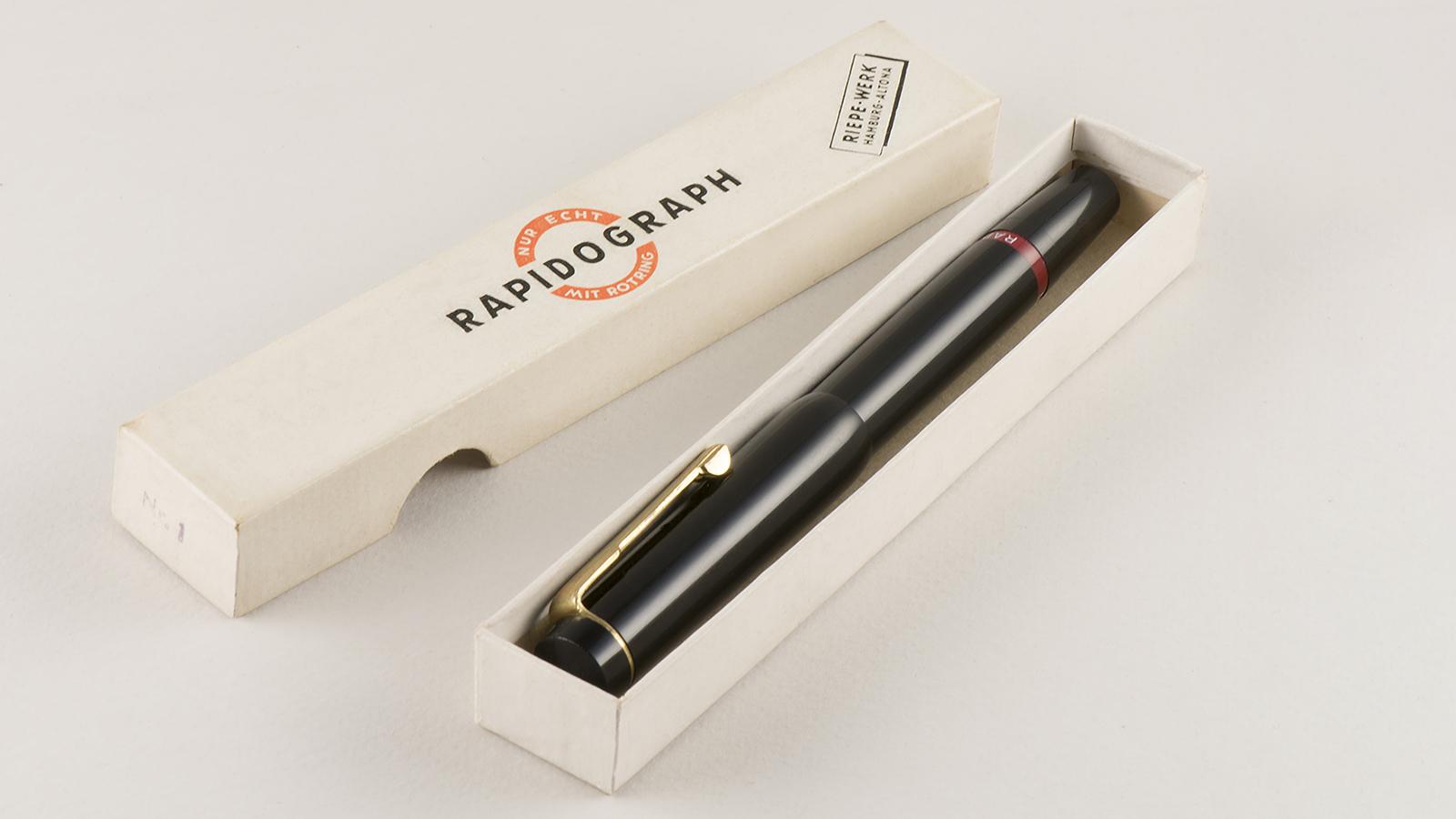
1953 marks the date when draftsmen, architects, engineers and graphic artists all around the world have been provided with one of the biggest quality-of-life updates on their respective field of expertise that far: the true first “technical pen” with standardized nib size, the rapidograph. While sounds so mundane when we try to comprehend from today’s point of view, if we try to understand what has been changed with the “standardized nib size” feature of the rapidograph, picture would be more clear even to our “perfectly” taken-for-granted-to-all-and-everything-surrounding-us aligned eyes.
Before rapidograph, technical drawing artists (of any kind) would be using ruling pens with adjustable heads which would change the lineweight under pressure, all of which would require an extreme craftsmanship by the user to operate on precision that the drawing needs.
You see, technical drawing is not an art form, though it is describing the work of people who might be considered as artists (namely, architects, graphic designers, and even engineers) visually. It has no room for “artistic touch” on its level of execution. Technical drawing should be considered as almost a scientific expertise with the rules, methods and ways of delivering the data.
Therefore, one should expect a rejoiceful reception upon the launch of the Rapidograph, since the expertise itself was (and still is) complex enough, such an update on the means of execution, would ease the difficulty of operation.
Na-ah!
Instead of accepting the first true technical pen with both arms open, people started questioning the tool by its elimination power on the required skillset for an individual to be a true technical drawing person. Some thought, if it becomes that easy, then everybody would become a technical drawing artist, even without the skill, even without the talent.
Most probably forgetting that it is not the tool that draws the line, but the person who holds it.
Countless occasions of similar receptions against the new tool, tech or method have happened: CAD softwares like AutoCAD replaced the rapidoghraph, but did not reduce the numbers of technical drawing artists, nor the architects. Instead, speed up the production process. BIM softwares like Revit enabled rapid communication among architects, engineers and production team on the field, strengthening the information delivery mechanism that building should hold, not ending the careers of contractors. RealTime rendering softwares like Lumion or Twinmotion make it possible for all to visualize their designs without the hustle around the materials, scene assets and lighting, still the numbers of beautiful renders are not greater than before.
The point is, while all these make it available for everyone with a fraction of the skill that is needed compared to the days of the past, without the basic understanding towards the expertise, it should not be possible for anyone to become the true expert on the field.
And history does not repeat. It rhymes.
When generative ai tools started circulating over the web, they became the ultimate tool for content creation for all ages. From “alien abducting your cat” videos to “turn yourself into a royalty” images, people loved what can be achieved. Months and even years worth of machine learning processes to develop those great tools and astronomic budgets to maintain them by means of data centers were merely accepted as toys in the hands of unknowing “children” of the internet.
That did not take too long for the people to consider this new tech as a production tool of course. When the potential of cutting costs of traditional photography was discovered, it was on! EVERYBODY WAS DOING THAT.
But the tech was designed for EVERYBODY. And EVERYBODY’s not sharing the same enthusiasm for the niche topic of photography did not make it possible for the developers of the tech even to consider to focus on realism at that point.
All has changed with one huge trolling like campaign by Google, back in July 2025, almost a year from this day. Sharing content with banana pictures in them from various employees, and images that exceed the quality of any possible outcome with the AI-gen tools of the day, made people start conspiring about one single possible result: Google was developing its own Gen-AI tool.
And not so long from when the conspiracy surfaced, NanoBanana was launched to public use on August 25th, 2025. The rest -as they say- is history.
A history that rhymes.
It became so simple for even everyday users to create a photorealistic output, now people began to sing the same song of “What if this new tech replaces this and that”, this time it was sung for the photographers, modeling agencies, studios and everyone who would be involved in this industry.
This also sparked a fire for developers from all around the world: Seedream came from far east to enhance the capabilities of Gen-AI where NanoBanana lacks, Google responded with NanoBanana 2 and then the Pro versions. Video creation tools got out of control almost, no one was 100% sure if what they were seeing was real or not. Without the monopoly on the topic, this rivalry only resulted in more and better tools for us, people. If one can not get the result their hearts desire with one of the tools, then it is easy to move on with the next one, and there is always a “next one” now.
Companies are redirecting their campaigns to involve AI generated outputs as well. “Why wouldn’t they?” one should ask. Of course, when it is this cheap (?), fast (??) and manageable (???) .
Since “EVERYBODY DOES THAT” no one questions if it is really that cheap, fast or manageable: rolling the dice multiple times to get the desired results, just because the one who uses it does not have total control over the product, or has the understanding over the field, actually renders the overall experience as a game of luck, taking out the precision that is required, and it seems no one ever cares since throwing millions of darts would eventually hit the bullseye.
Skills and precision on the other hand would guarantee the bullseye each and every time you take a shot.
Most probably, people still are forgetting that it is not the tool that draws the line, but the person who holds it.
Here at Fengs, we change that.
Stay tuned for more. The wait is almost over.